

About this variety
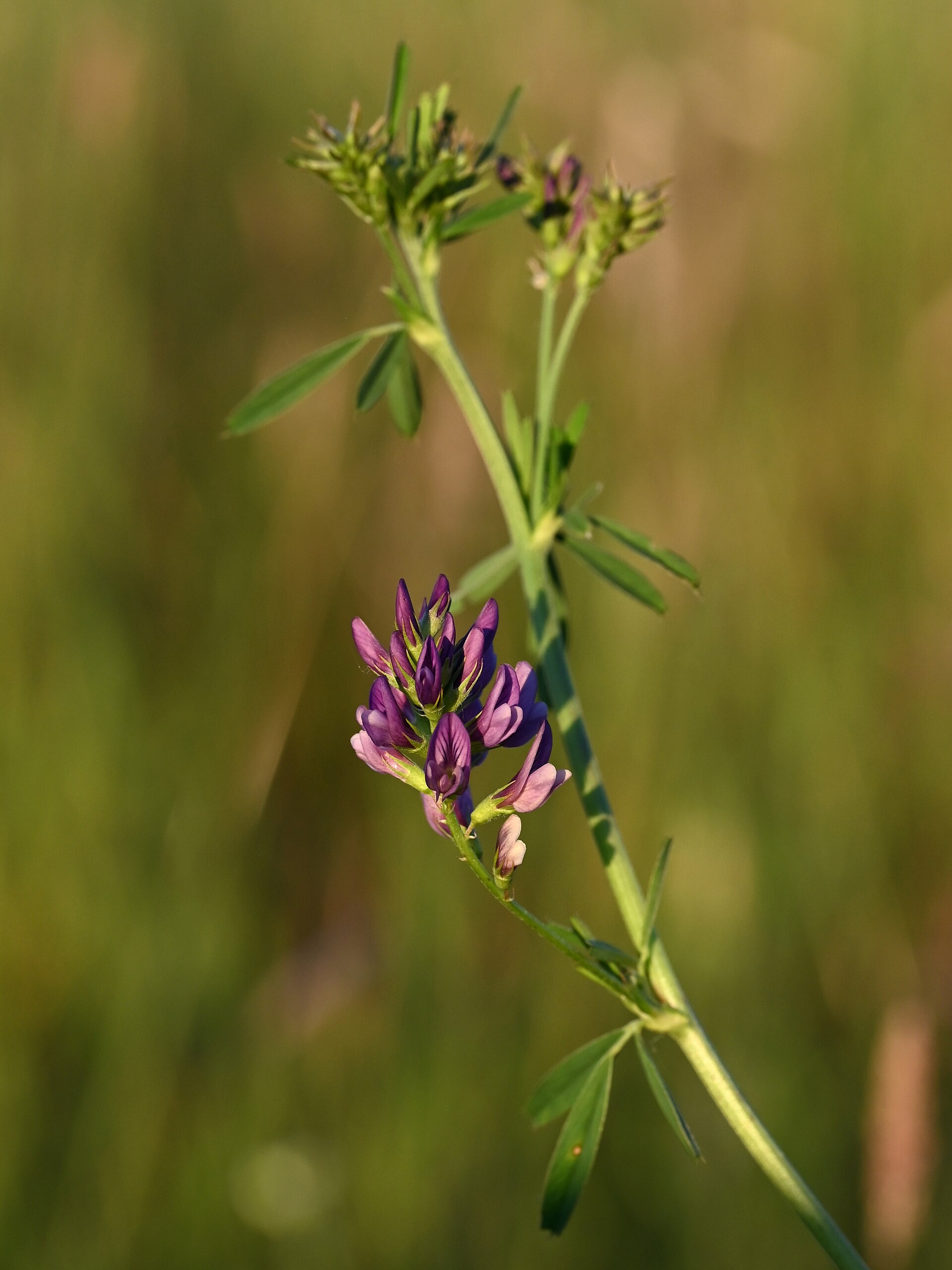
Alfalfa (Medicago sativa), also called lucerne, is a long-lived perennial forage legume with a deep taproot. It suits deep, well-drained soil of pH 6.5 or above, and its small seed goes into a firm seedbed only 3–13 mm deep.
Also known as: Lucerne (UK, Australia, New Zealand, South Africa), Purple medick, Luzerne (French, German), Erba medica (Italian), Luzerna, Yonca (Turkish), Yonjeh (Persian).
What the plant becomes
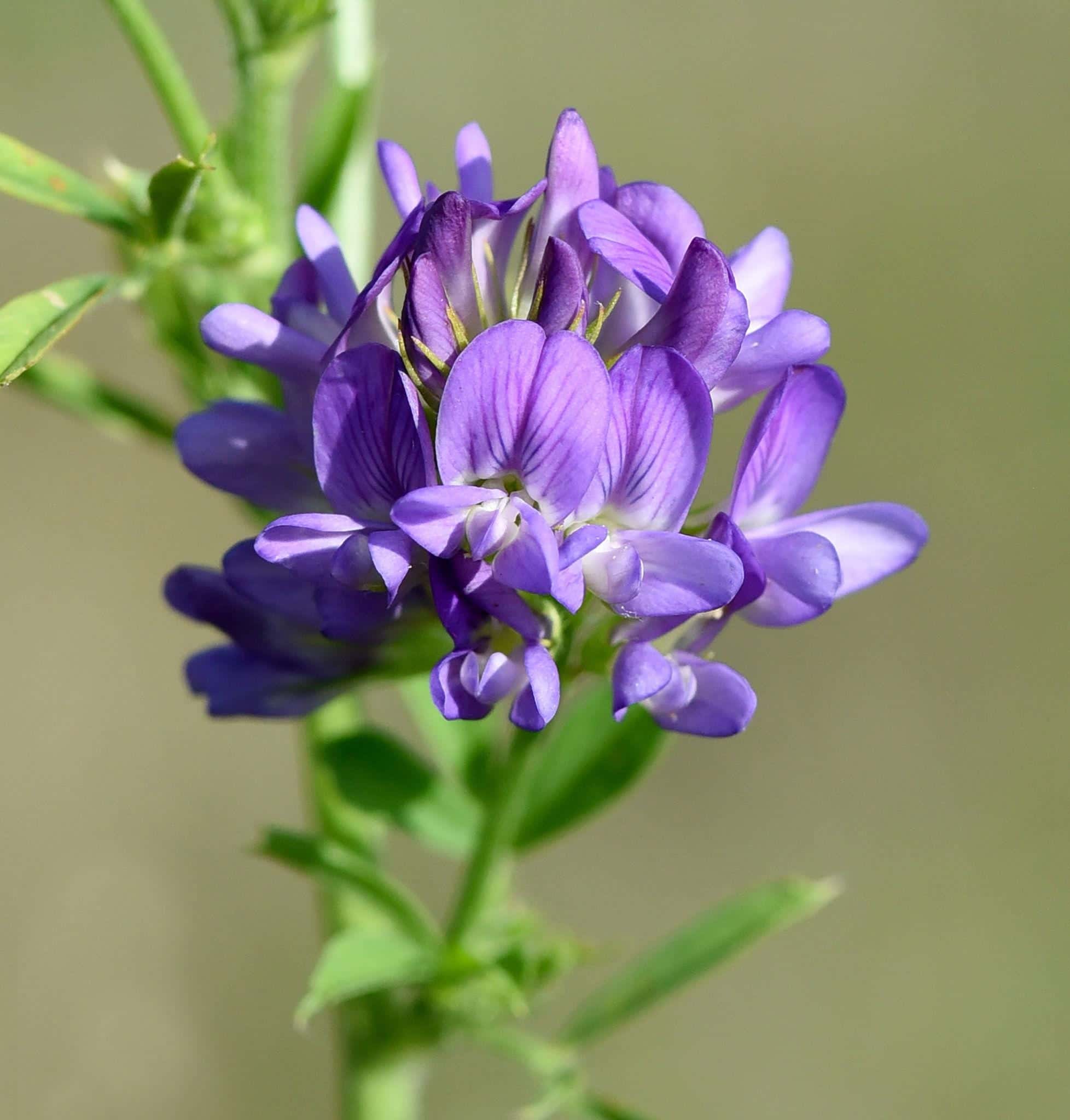
Alfalfa grows upright stems from a persistent crown, with trifoliate leaves and a taproot that is typically 2–3 m long where the subsoil allows. Flowers are usually purple but can be blue, yellow or cream. A stand normally lives four to eight years and sometimes much longer, depending on variety and climate. Root-nodule bacteria (rhizobia) fix nitrogen for the plant.
Sowing
- Seedbed: smooth, firm and well drained, so the seed touches the soil and takes up moisture; keep it moist through germination and emergence.
- Depth: 3–6 mm in loam or clay loam, 6–13 mm in sandy soil.
- Soil: deep, friable, well drained, pH 6.5–6.8. Avoid sites with frequent flooding or a high water table.
- Forage stands: drilled seeding rates of 18–25 lb of pure live seed per acre (about 20–28 kg/ha) are used.
Uses and limits
Alfalfa is grown for hay, forage, pasture mixtures and seed production. Laboratory germination tests hold the seed at a constant 20 °C and count at 4 and 10 days; this is an approximate species value, not a result for this lot. Choose management for your climate and intended use.
FAQ
How deep should alfalfa seed be planted?
Shallow: about 3–6 mm in loam or clay loam and 6–13 mm in sandy soil, in a firm seedbed.
What soil suits alfalfa?
Deep, well-drained soil with a pH of 6.5 or above. Poor drainage and acid subsoil restrict the deep root system.
How long does an alfalfa stand last?
Usually four to eight years; local stands range from about two to seven years in extension reports.
Local names
Lucerne, Foder-lucerne, Echte Luzerne, Medick, Purple medick, Rijka, Luzerne, Erba medica, Luzerna, Yonca, Yonjeh, Alfalfa.
Common names of Medicago sativa
All 45 names, languages and regions
Local names
| Belgium | |
|---|---|
| English | Lucerne |
| Denmark | |
| Danish | Foder-lucerne |
| Germany | |
| German | Echte Luzerne |
| United States | |
| English | Medick |
| Other places | |
| Latin | Erba medica |
| English | Alfalfa |
| American English | alfalfa |
| Walloon | Advalfa |
| Portuguese | Alfafa |
| Swedish | Alfalfafrö |
| Manx | Alfalfey |
| Catalan | Alfals |
| Aragonese | Alfalz |
| Filipino | Alpalpa |
| Basque | Argi-belar |
| Vietnamese | Cỏ linh lăng |
| Italian | Erba medica |
| Albanian | Jonxhë |
| Turkish | Kaba yonca |
| Croatian | Lucerna |
| Polish | Lucerna siewna |
| Romanian | Lucernă |
| Finnish | Luserni |
| French | Luzerne cultivee |
| Dutch | Luzerneklaver |
| Ido | Luzerno |
| Icelandic | Lúserna |
| Welsh | Maglys |
| Lithuanian | Mėlynžiedė liucerna |
| Lucerne, Purple medick, Rijka, Luzerne, Luzerna, Yonca, Yonjeh, Módra šlinčina, Otá'tavö'êstse, Séwnô lucerna, jajukgaejari, niisniikou'usei'i, sonabü, Дүжер-меде тарымал (Düzher-mede tarymal), برسيم (Bersim), لوسن (Lawsan), وێنجە (Winje), یوْنجا (Yunja), 자주개자리 (Jajugaejari) | |