
Seed preparation
Use fresh nuts with all the green husk removed (RHS). Sow or stratify them in the season they are bought and keep them cool until then.
Nut tree growing guide
Walnut seed needs two to four months of moist cold before it sprouts, so fresh nuts are either sown outdoors in late autumn or chilled in damp sand and sown in spring. A seedling makes a fine shade tree or a rootstock, but its nuts will not match the parent; named varieties are grafted.
Use fresh nuts with all the green husk removed (RHS). Sow or stratify them in the season they are bought and keep them cool until then.
Not needed. The USDA manual describes embryo dormancy, which cold breaks; the shell itself is not the barrier, so leave it whole.
The embryo is dormant until it has had a cold, moist period. Himalayan nurseries layer nuts in moist sand in a pit or box at 2-5 °C (36-41 °F) for 60-100 days; the USDA manual gives 90-120 days in a plastic bag of moist peat or sand for small lots. In snowy areas nuts sown outdoors from late November to early December get their cold naturally.
In Indian nursery practice nuts are soaked for 5-8 days in December, in running water or water changed daily, before stratification.
After chilling, the USDA test uses 30 °C (86 °F) by day and 20 °C (68 °F) at night, which matches a warm spring. Unchilled nuts usually stay dormant.
About 5 cm (2 in) in a nursery bed (USDA) or 5-7.5 cm (2-3 in) in Himalayan nurseries; the RHS sows about 3 cm (1.2 in) deep in pots. Nursery rows: 10-15 cm between nuts and 20 cm between rows.
Light sandy or sandy loam soil with no risk of waterlogging, enriched with well-rotted manure at about 5-6 kg per square metre (Indian Farming). In pots, use gritty, well-drained compost.
Keep evenly moist. After autumn sowing, Himalayan nurseries mulch beds with about 10 cm of dry grass and remove it when seedlings appear.
Not needed for germination; young trees tolerate light shade (RHS).
Seedlings emerge in spring once the cold requirement is met and the soil warms. Screen seed beds and stratification boxes: rodents dig up walnuts.
In Indian nurseries seedlings are moved from the seedbed to nursery beds at 5-6 cm (2-2.5 in) tall with 3-4 leaves, and need about two years to reach planting size.
Plant young trees under about 3 m (10 ft); avoid pot-bound stock and protect the taproot (RHS). Choose deep, well-drained soil, at least 1.8 m (6 ft) deep according to Oregon State University, in full sun and out of frost pockets. Space trees 9-18 m (30-60 ft) apart.
To get known nuts, graft a named variety onto a one- to two-year-old seedling. In the mid-hills of the north-west Himalaya chip budding in mid-May to early June gave about 81-89% success, against about 50% for patch budding.

The walnut embryo stays dormant until cold, moist conditions break its dormancy, and the oil-rich kernel loses vigour if kept dry and warm. A practical check before sowing: crack one or two nuts from the batch, as the RHS advises at harvest. A plump, fully formed kernel means the rest are worth stratifying; a shrivelled or empty one means the batch is poor.
Walnut is a crop of the north-west Himalaya, from 900 to 3,500 m, in Jammu and Kashmir (over 85% of output), Himachal Pradesh, Uttarakhand and Arunachal Pradesh, extending to Sikkim and Darjeeling. Sow in late November-early December where snow falls; stratify in a refrigerator elsewhere.
Grafted trees begin cropping after about four years (RHS); Oregon State reports a few nuts at 5-6 years and full production at about 10 years.
Prune only between midsummer and early autumn, because walnut cuts bleed sap at other times. Walnut does not tolerate hard pruning.
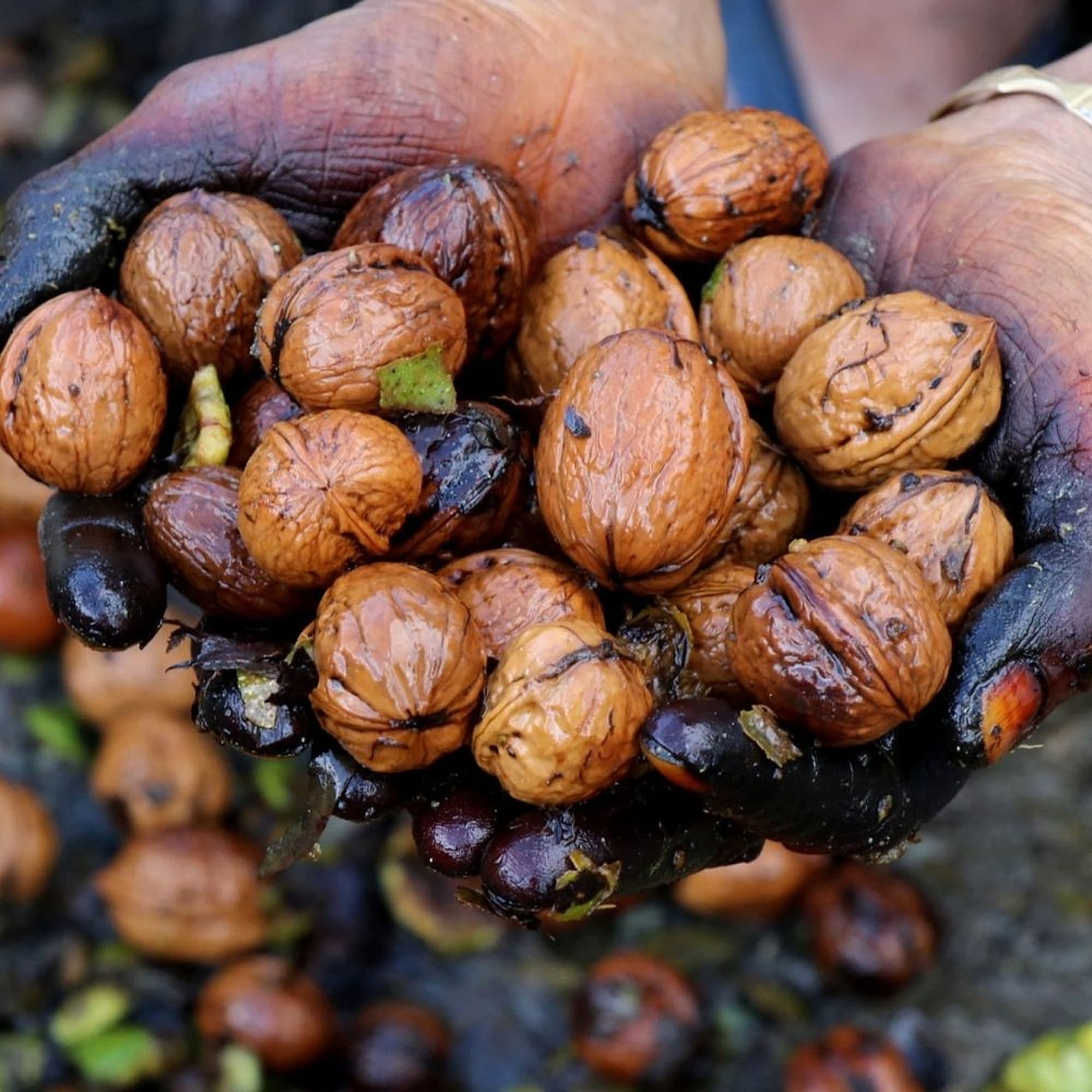
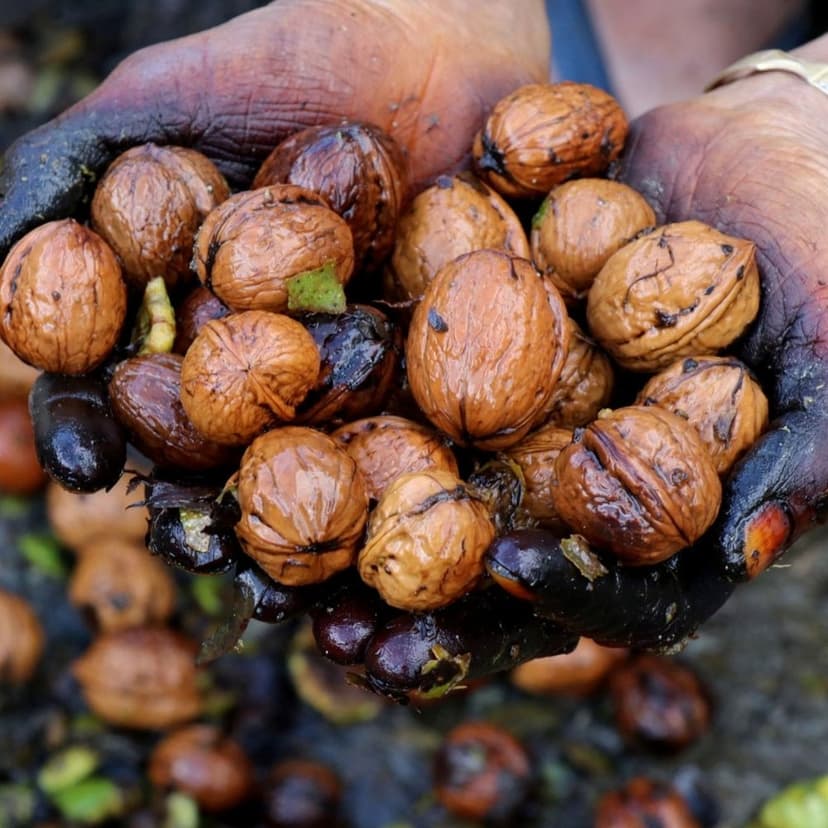
Nuts are ripe when the husk splits in autumn. Remove the husk wearing gloves, since it stains skin, and dry the nuts at no more than 40 °C (104 °F) before storing them cool and dry.
Chill fresh Himalayan walnuts over winter and raise sturdy seedlings for shade trees or for grafting.
Yes. The embryo is dormant until it has had moist cold: Himalayan nurseries keep nuts in damp sand at 2-5 °C for 60-100 days, or sow them outdoors in late autumn where snow provides the cold.
It may, but it will not match the parent. Most older Indian orchards grew from seedlings and vary widely in yield and nut size, which is why seedlings are budded with proven varieties.
Walnut is a crop of the north-west Himalaya between about 900 and 3,500 m. It needs winter cold for its seed and, according to Oregon State, heat near 38 °C (100 °F) damages the kernels.
