

About this variety
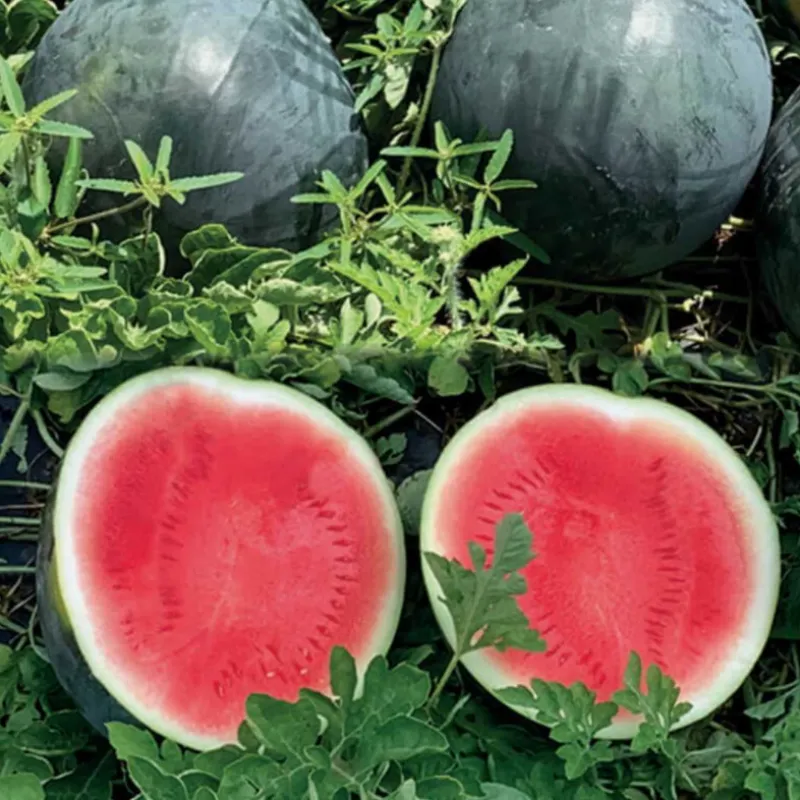
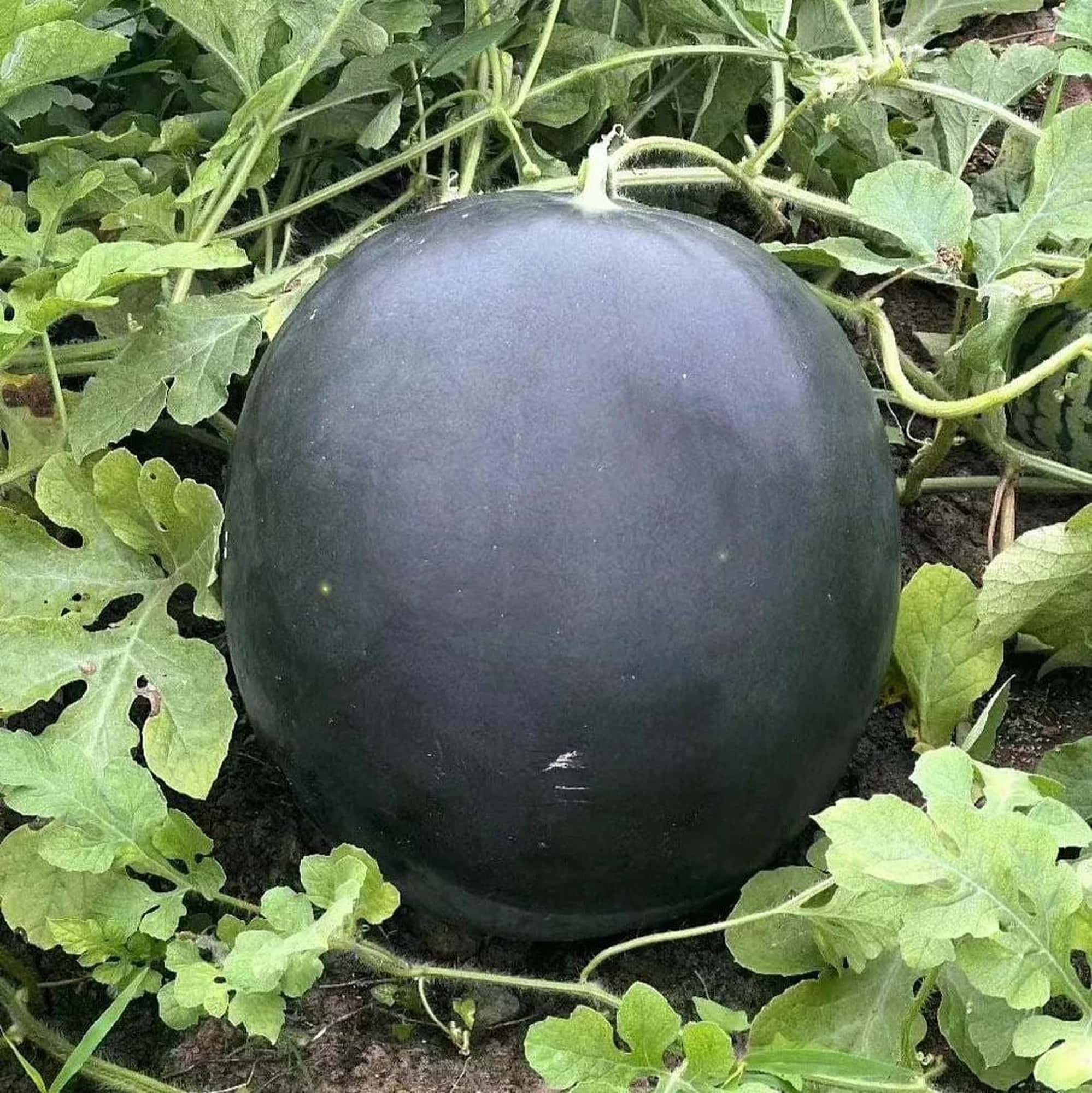
Round Black watermelon (Citrullus lanatus) is a sprawling vine grown for its deep black rind and sweet flesh. The seed wants warm soil: the optimum is about 21–35 °C, and germination is very slow below about 21 °C, so sow only once the ground has warmed.
Also known as: Tarbooz, Kalingad, Puchakaya, Tharpoosani, Sandía (Spanish), Pastèque (French), Wassermelone (German), Arbuz; scientific synonym Citrullus vulgaris.
Sowing: soil temperature and depth
- Soil temperature: optimum about 21–35 °C (approximate, typical for the species).
- Depth: about 25–51 mm (1–2 in), also an approximate species value.
- Indoors: sow a few weeks before the last frost and transplant once frost risk has passed. Seedlings are fragile and easily damaged by frost and root disturbance, so keep the root ball intact.
Pollination and fruit set
Watermelon bears separate male and female flowers. Males open first, often one to two weeks before the females, which show a small swelling behind the petals. Without bees moving pollen between them, no fruit forms. If bees are scarce, brush pollen from a freshly opened male flower onto the centre of a female flower. Heat above 35 °C reduces bee activity and can make flowers drop.
Space and timing
Allow 1.8–2.4 m (6–8 ft) per plant in a home garden, because the vines sprawl. Expect 80–100 days from seed to ripe fruit, and about 35 days from pollination to harvest.
FAQ
Why have my watermelon seeds not come up?
Cold soil is the usual cause. In a university table, seedlings appeared after 12 days at 20 °C but after only 5 days at 25 °C, 4 days at 30 °C and 3 days at 35 °C. Check the soil temperature before you re-sow.
How do I tell when the fruit is ripe?
The tendril nearest the fruit turns brown and dries, the ground spot changes from white to light yellow, and a thump sounds hollow rather than metallic.
How long does leftover seed stay viable?
About 4 years when kept cool, dark and dry. This is an approximate value for watermelon in general, not a test result for this lot.
Is Citrullus vulgaris the same plant?
It is an older name, given by Schrader in 1836. The accepted name now is Citrullus lanatus.
Local names
Vandmelon, vesimeloni, Citrulle laineux, vannmelon, vassmelon, Citrulle laineux, Pastèque, Citrouille, Melon d'eau, vattenmelon, Water Melon, Tarbooz, Kalingad, Puchakaya, Tharpoosani.
Common names of Citrullus lanatus
All 45 names, languages and regions
Local names
| Denmark | |
|---|---|
| Danish | Vandmelon |
| Finland | |
| Finnish | vesimeloni |
| Mayotte | |
| French | Citrulle laineux |
| Norway | |
| Norwegian | vannmelon |
| Norwegian Nynorsk | vassmelon |
| Réunion | |
| French | Citrulle laineux, Pastèque, Citrouille, Melon d'eau |
| Sweden | |
| Swedish | vattenmelon |
| United Kingdom | |
| English | Water Melon |
| Other places | |
| Spanish | Sandía, albudeca |
| French | Pastèque |
| German | Wassermelone, Dessert-Wassermelone |
| Latin | Citrullus vulgaris |
| English | bastard-melon, dessert watermelon, Wild Watermelon |
| Italian | Anguria |
| Turkish | Karpuz |
| Welsh | Melon Dŵr, Melonau Dŵr |
| Lithuanian | Tikrasis arbūzas |
| Dutch | Watermeloen |
| Portuguese | angúria |
| Estonian | harilik arbuus |
| Greek | karpouzia |
| Czech | lubenice obecná |
| Korean | subag |
| Japanese | suika |
| Chinese | xi gua |
| Simplified Chinese | 西瓜 (xigua) |
| Asturian | melonar d'agua |
| Slovenian | lubenica |
| Tarbooz, Kalingad, Puchakaya, Tharpoosani, Arbuz, Dessert-Wassermelone (DE), Melon d'eau (FR), Patia, Watermelon (EN), subag, suika, watermelon, wild melon, xi gua, 수박 (subak) | |