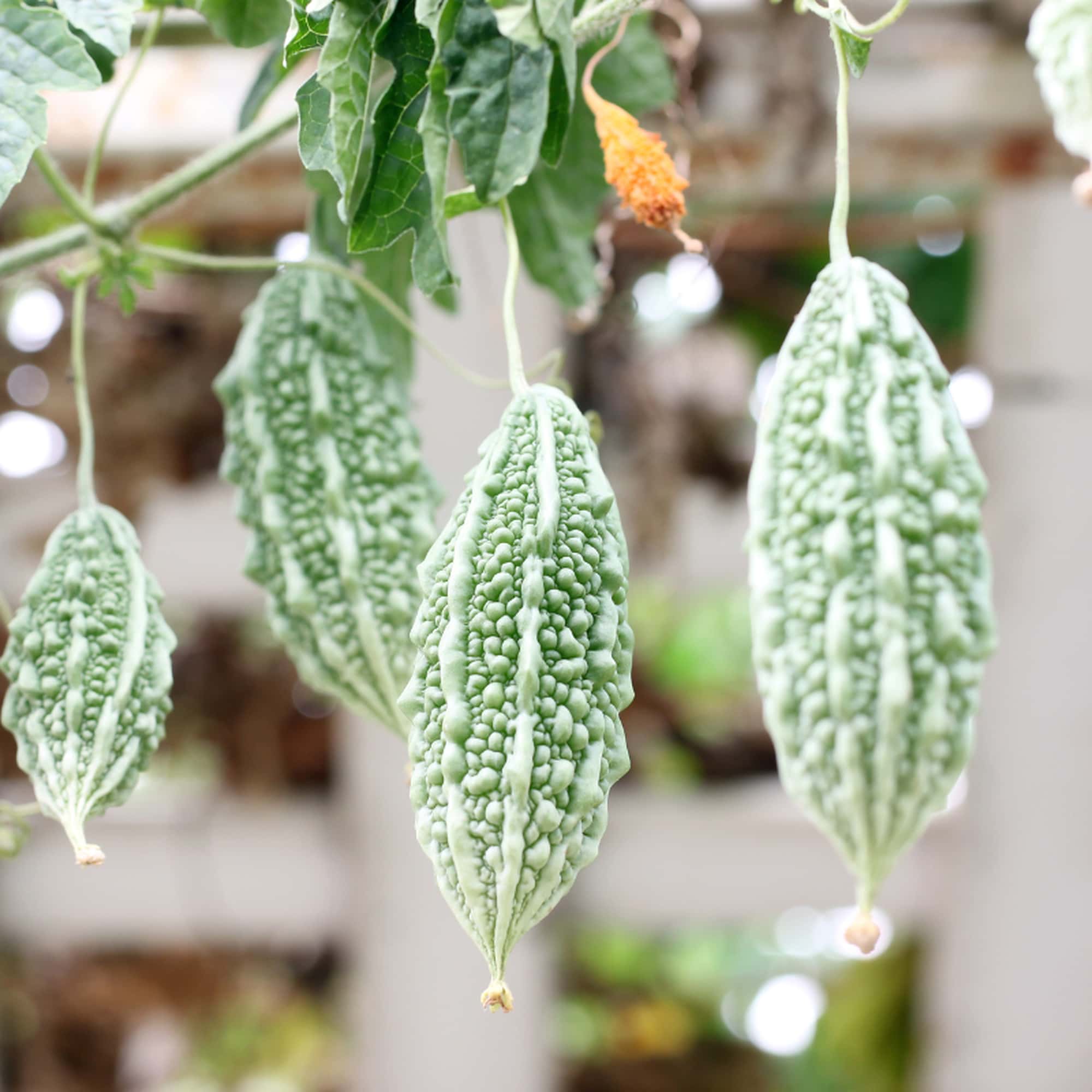


About this variety
Jaunpuri (Momordica charantia) is a bitter gourd with long, cylindrical, deeply ridged, deep green fruits that reach 25–30 cm. It is a frost-tender annual climber, and its hard-coated seed germinates best near 25 °C after soaking and scarifying.
Also known as: Bitter melon, Bitter gourd, Balsam pear, Bitter squash, Karela (Hindi, Urdu), Kakarakaya (Telugu), Pavakkai (Tamil), Kaipakka (Malayalam), Ampalaya (Filipino), Goya (Okinawan), Ku gua (Chinese).
The fruit and its use
The name points to Jaunpur in Uttar Pradesh. The fruit is firm and strongly bitter, and it is cooked in stir-fries, curries and stuffed dishes, and pickled, in Indian and South-East Asian kitchens. Pick it while green or slightly yellow.
Sowing: a hard seed coat
- Soak the seed in water for 12–24 hours; extension sources also recommend scarifying the thick coat for the best germination.
- Temperature: 20–30 °C in laboratory tests, best near 25 °C; below 20 °C and above 30 °C germination dropped (approximate species values).
- Depth: about 20 mm (¾ in), two or three seeds per hole.
- Spacing: 60–90 cm between plants.
- Cold or dry soil can make seed slow or fail to germinate.
Trellis and pollination
The vine can reach about 5 m, so it needs a trellis or netting, which also keeps fruit off the ground. Each plant bears separate male and female flowers. Bees and other insects pollinate them; if few visit, transfer pollen by hand from male to female flowers in the daytime.
Harvest
Expect the first fruit about 50–60 days after sowing; a Florida extension guide gives about 50 days in north Florida. Fruit left on the vine turns orange and splits at the end, showing seeds in a red coat. For cooking, pick before that stage.
FAQ
Why have my bitter gourd seeds not come up?
The usual causes are soil colder than 20 °C or a dry bed, and the thick seed coat. Soak and scarify the seed, keep the soil moist, and sow when it is warm.
Is the fruit still usable when it turns orange?
An orange fruit is fully ripe and splits open. Its red seed coat is sweet, but a Florida extension guide advises eating bitter gourd while green or slightly yellow.