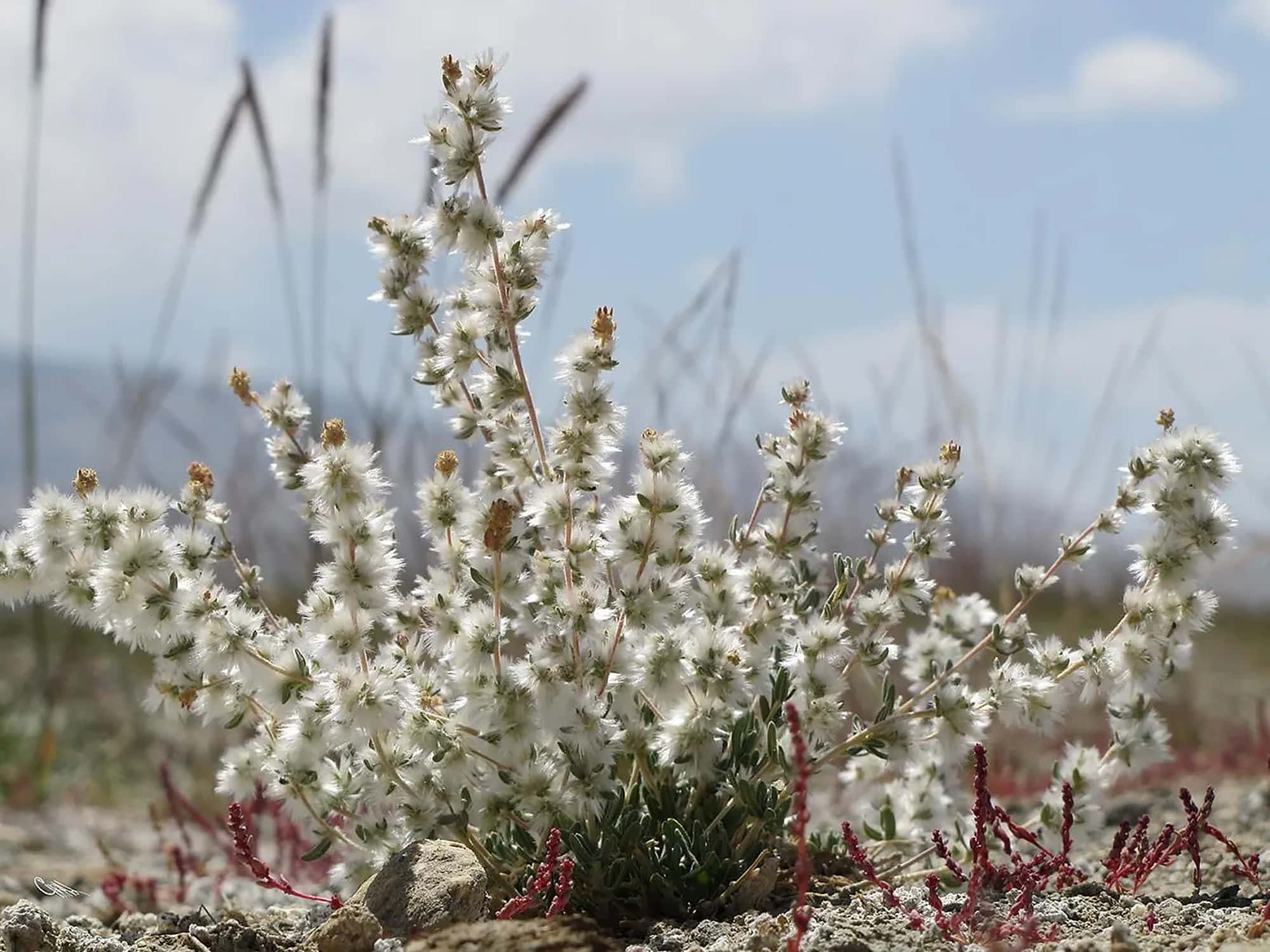


About this variety
Eurasian winterfat (Krascheninnikovia ceratoides) is a silvery, woolly perennial subshrub up to about 1 m tall, in the Amaranthaceae. Its fruit is only about 3 mm long and wrapped in hairy bracteoles, so sow it thinly, press it in and cover it only lightly.
Also known as: Eurasian winterfat, Winterfat, Teresken, Hornmelde (German); scientific synonyms Eurotia ceratoides, Axyris ceratoides and Diotis ceratoides.
Identity and range
Kew accepts it as a perennial or subshrub native from southern Spain and eastern Central Europe across temperate Eurasia to China. Dense stellate hairs give the young stems and foliage their pale, softly woolly look.
Site: drainage and soil
Winterfats as a group are drought-resistant but do not tolerate flooding, excess water or acidic soils; they prefer well-drained, calcareous soils. A USDA NRCS release on the North American relative K. lanata advises against sites below pH 6.5 and notes that seedlings can be damaged by frost. Treat these as guides for Eurasian winterfat, not measured values for it.
Sowing
- Fill a tray or small pots with a fine, free-draining mix and level the surface.
- Scatter the seed thinly, press it into contact and cover only lightly. NRCS gives no more than ¼ in (about 6 mm) for K. lanata.
- Mist gently and keep the surface evenly moist, never saturated.
- Give bright light and fresh air; transplant into single pots when the seedlings can be handled.
We hold no saved seed specification for this species, so we state no germination temperature, emergence time or percentage. NRCS reports that K. lanata seed stays viable for about two years and loses viability quickly in open storage, so keep your seed sealed, dry and cool.
FAQ
Is this the same plant as American winterfat?
No. Krascheninnikovia has three accepted species: K. ceratoides (Europe to East Asia), K. fruticulosa (Asia) and K. lanata (North America). Where this page borrows from K. lanata, it says so.
Is it a herb or a spice?
No source we hold describes culinary use. It is a woolly ornamental and forage-type subshrub, and we make no culinary claim.