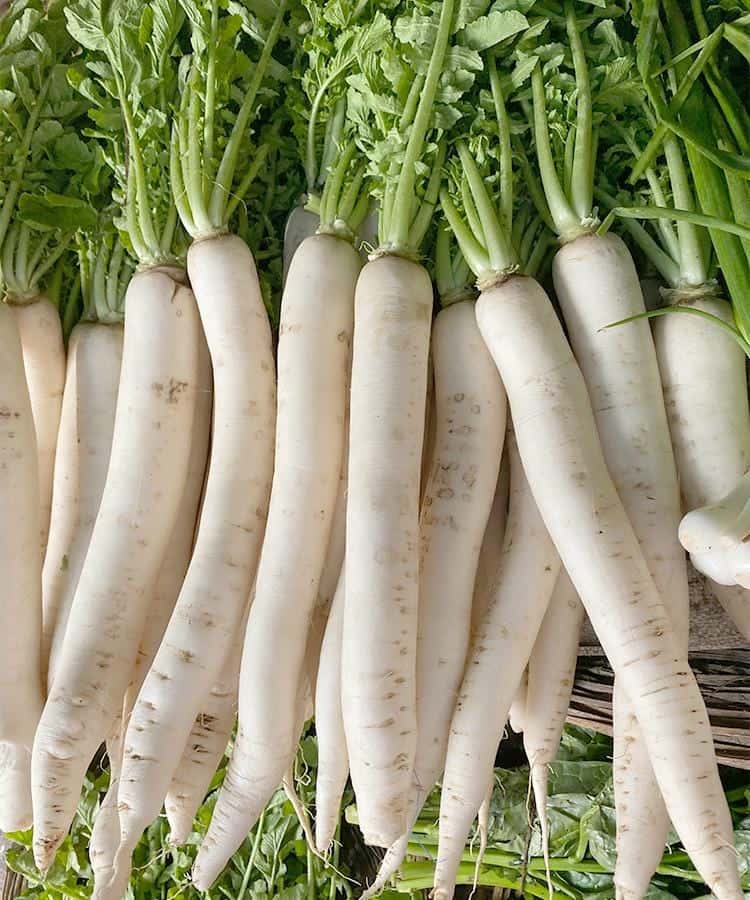


About this variety
Product Overview: Grow long white daikon radish from this packet of 100 seeds. Daikon is a cultivated radish in the mustard family, Brassicaceae. The widely used botanical name is Raphanus sativus L.; Royal Botanic Gardens, Kew currently treats that name as a synonym of the accepted Raphanus raphanistrum subsp. sativus. UF/IFAS describes daikon as the Longipinnatus Group, a long-rooted radish type. This packet is labelled Long White Daikon but does not name a specific cultivar, so no cultivar-specific maturity, root-length, heat-tolerance, or resistance claim is made.
- Common name: Long White Daikon Radish
- Botanical name in common horticultural use: Raphanus sativus L.
- Accepted taxon: Raphanus raphanistrum subsp. sativus (L.) Schmalh.
- Family: Brassicaceae
- Packet quantity: 100 seeds
Sowing Long White Daikon
Timing: Daikon is best treated as a cool-season vegetable. Select a sowing period that gives the roots time to develop without prolonged hot weather. Local planting dates vary widely, so use regional extension guidance and current weather rather than a fixed worldwide calendar.
Direct sowing: Sow where the plants will grow because disturbing a developing taproot can affect its shape. UF/IFAS gives a sowing depth of approximately 1/2-1 inch (1.3-2.5 cm) in its daikon production guide. Cover the seeds with loose soil, water carefully, and keep the seedbed evenly moist while seedlings establish. Excessive irrigation or heavy rain can form a surface crust that makes emergence more difficult.
Soil preparation: Choose loose, well-drained soil and remove stones, hard clods, and other physical obstructions before sowing. Compacted or stony soil can restrict, fork, or distort a long taproot. Raised beds can be useful where the native soil is shallow or drains poorly, provided the bed is deep enough for root development.
Spacing and Care
Thinning and spacing: Thin seedlings early instead of allowing them to remain crowded. UF/IFAS suggests 4-6 inches (10-15 cm) between daikon plants and wider row spacing in field production. A home gardener can adapt the row layout to the available bed, but each plant still needs enough space, light, moisture, and soil volume to form an enlarged root.
Water: Keep soil moisture reasonably consistent without leaving the root zone waterlogged. Long dry periods followed by heavy watering can interfere with steady growth. Apply water gently enough that the seedbed is not washed away, and check raised beds or containers more frequently because they may dry faster than ground soil.
Fertility and weeds: Avoid using fresh, high-nitrogen manure immediately before sowing. UF/IFAS notes that excessive nitrogen can encourage lateral root branching. Use locally appropriate, soil-test-based fertility guidance where available. Remove weeds while they are small so that they do not compete with the young radish plants, taking care not to disturb the developing roots.
Harvest
Harvest when the roots have reached a useful size for your kitchen and before they become over-mature. UF/IFAS notes that daikon can become increasingly fibrous and stronger in flavour when left too long. Loosen the surrounding soil before lifting long roots to reduce breakage. Wash harvested roots and leaves before use.
Daikon roots may be sliced or grated for salads, cooked in soups and stir-fries, roasted, or prepared as pickles. Culinary preference varies, and this seed listing does not promise a particular flavour intensity or root dimension.
What You Receive: One labelled packet containing 100 Long White Daikon Radish seeds. The packet contains seeds only, not roots, seedlings, or a named daikon cultivar.
Frequently Asked Questions
Is Long White Daikon a named cultivar?
Not in this product record. Long White Daikon describes the crop type and root form; the packet does not state a cultivar such as Minowase, Alpine, or Miyashige.
Should daikon be transplanted?
Direct sowing is preferred because daikon forms an enlarged taproot. Sowing in its final position avoids transplant disturbance and gives the root a straight path into prepared soil.
Why is loose soil important?
A long root needs unobstructed soil volume. Stones, compaction, and hard clods may restrict or split the developing root, while loose, well-drained soil allows it to expand more freely.