About this variety
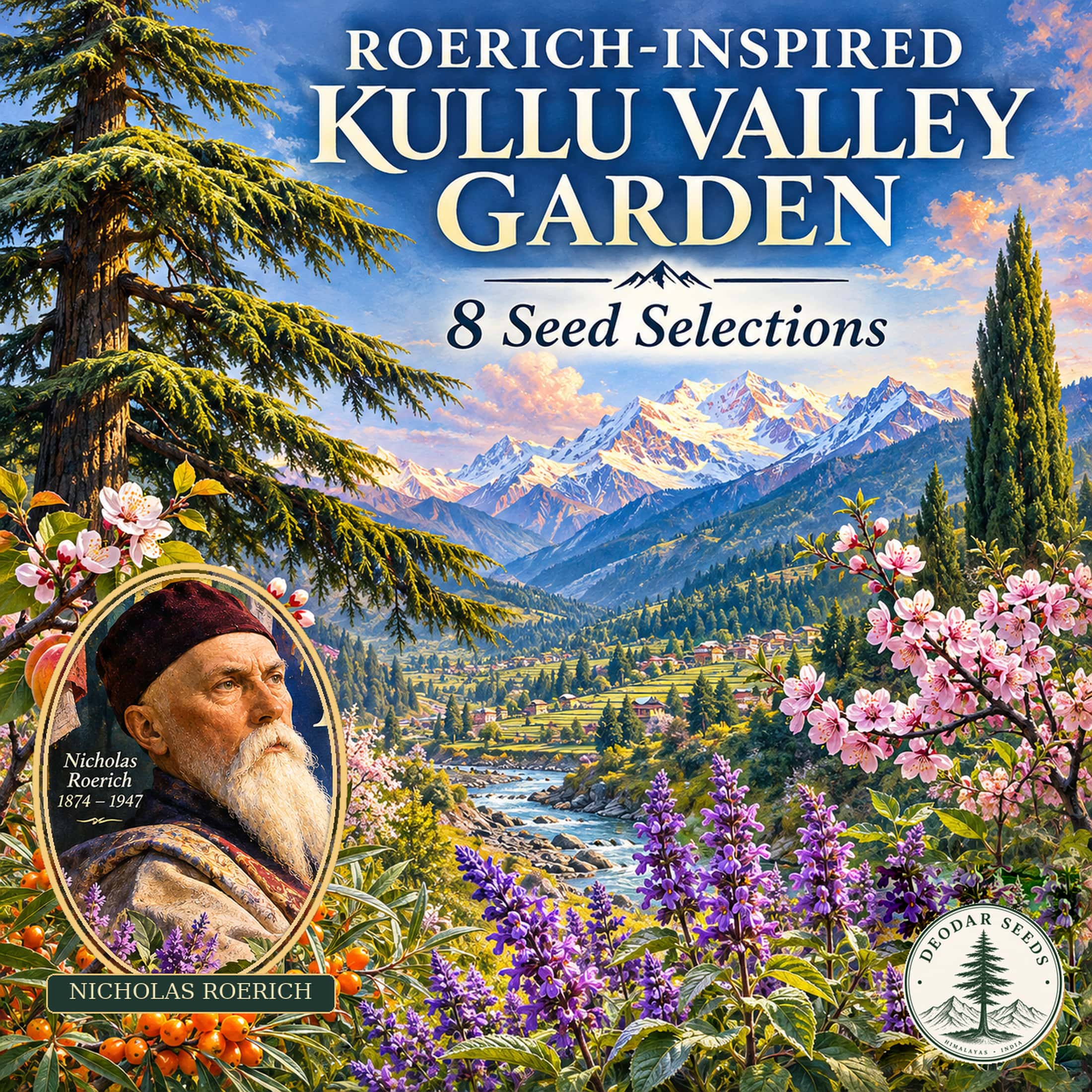
Roerich-Inspired Kullu Valley Garden — 8 Seed Selections
A distant ridge, dark conifers and a garden catching the light: the landscapes associated with Roerich offer an invitation to think in years, not weekends. This collection begins with seeds and leaves space for a living landscape to develop slowly.
Eight separately labelled selections combining long-term trees and shrubs with flowering perennials, inspired by the Kullu Valley landscape and Roerich’s mountain imagery.
What is included
350 seeds across 8 individually labelled seed selections. Supplied as seeds for sowing, not live plants or harvested ingredients.
| Selection | Botanical identity | Seeds |
|---|---|---|
| Deodar cedar (Cedrus deodara) | Cedrus deodara | 20 |
| Himalayan cypress | Cupressus torulosa | 20 |
| Himalayan apricot | Prunus armeniaca | 5 |
| Himalayan sea buckthorn | Hippophae rhamnoides | 20 |
| Himalayan climbing rose mix | Rosa spp. (cultivated mix) | 15 |
| Sweet cherry | Prunus avium | 20 |
| Yarrow pink & white | Achillea millefolium | 200 |
| Violet meadow sage | Salvia nemorosa | 50 |
The idea behind the collection
This is an independent themed collection, not affiliated with a Roerich museum or institution and not a promise of wild-collected Himalayan provenance. It includes large trees, thorny or spreading shrubs and variable seed-grown fruit plants. It is not a miniature landscape that can remain together in one pot, nor a quick fruit-harvest kit.
Sowing and growing
Keep every selection separate and labelled. Use clean containers with drainage and an appropriate seed-sowing medium. Select sowing dates for your climate rather than a single calendar date for the whole set. Where pretreatment is needed, stratification means a controlled moist period to help break seed dormancy, not freezing dry seed.
- Deodar cedar (Cedrus deodara): Use a free-draining propagation mix and keep it moist, not saturated. A cold, moist pretreatment may be used for dormant seed; label and monitor the batch rather than imposing one timetable on every seed. Grow seedlings in good light and plan for a large tree, not a permanent windowsill plant.
- Himalayan cypress: Use clean, sharply draining medium and protect small seedlings from extremes. The component guidance recommends a soak followed by cold, moist pretreatment before sowing. Maintain light moisture and airflow, then acclimate young plants gradually to outdoor conditions.
- Himalayan apricot: Apricot seed normally needs a cold, moist period before germination. Keep labelled seed in moist, not wet, medium during pretreatment and inspect regularly. Once growth begins, pot individually and provide bright light and drainage. Seedlings are not grafted named cultivars and may take years to fruit.
- Himalayan sea buckthorn: Plan for a cold, moist pretreatment and a sunny, well-drained permanent position. Grow several seedlings if future fruiting is an aim: male and female flowers occur on separate plants, and seed packets do not guarantee a sex ratio. Allow for thorns, suckering and long-term shrub size.
- Himalayan climbing rose mix: Treat this as a variable climbing-rose seed mix, not a guaranteed clone or flower colour. Rose seed may germinate irregularly and can require a prolonged dormancy-breaking period; a validated lot-specific schedule is not available. Keep sowings labelled and provide support as the young roses grow.
- Sweet cherry: Sweet-cherry seed can have substantial dormancy and may need both warm and cold moist phases before germination. Keep the medium drained, monitor regularly and avoid discarding sound seed solely because it is slow. Allow for a full-sized tree and variable, delayed fruiting.
- Yarrow pink & white: Sow shallowly in fine seed compost and water gently. Grow on in good light and plant into a sunny, well-drained position. Seed-grown flower colours may vary; manage spreading clumps and unwanted seedlings.
- Violet meadow sage: Sow in a clean seed mix, keep moisture steady and give emerging seedlings good light. Transplant established plants to a sunny, well-drained position. This is an ornamental meadow sage, not a substitute for culinary sage.
Your growing project
Draw a long-term planting plan before sowing. Start each selection separately, label pretreatments and dates, and reserve permanent sites only after checking mature size and climate suitability. Conifers need space; sea buckthorn needs a plan for pollination and suckering; roses need room and support. Seed-grown apricot and cherry may differ from their parents and may take years to fruit. Fruiting and flower colour are not guaranteed.
Important safety and growing notes
All seeds are for sowing only. Apricot kernels can release cyanide if eaten: never chew, taste or use them in food, and do not break stones open for tasting. Cherry kernels must not be eaten either. Keep all seeds securely away from children and pets. Wear gloves around rose and sea-buckthorn thorns. Ornamental sage is not culinary sage, and the collection is not for homemade medicines or teas.
Check local planting and import rules before ordering or growing unfamiliar species. Germination, mature appearance and performance depend on the seed and growing conditions; counts are not a promise of an equal number of established plants. Pots, compost, tools and other display items are not included.
About the images
The cover is a botanical illustration of the collection. Gallery photographs are references to individual plants, not photographs of the delivered seed packets or a guaranteed future harvest.